Prove it's exploitable.
Fix it before the exploit.
Time-to-exploit collapsed from years to hours, and rogue agents are on the loose. Konvu Agents start from your existing scanner findings, prove which ones work in your environment, and open the pull request that closes them.
In production at Fortune 500 and Nasdaq-listed companies.
Backed by founders and executives from







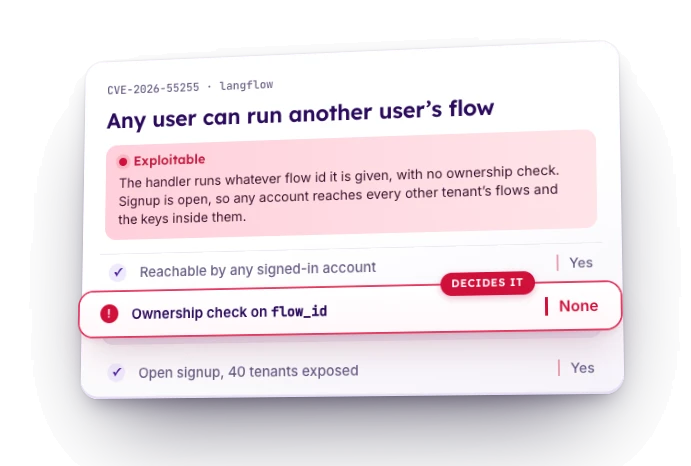
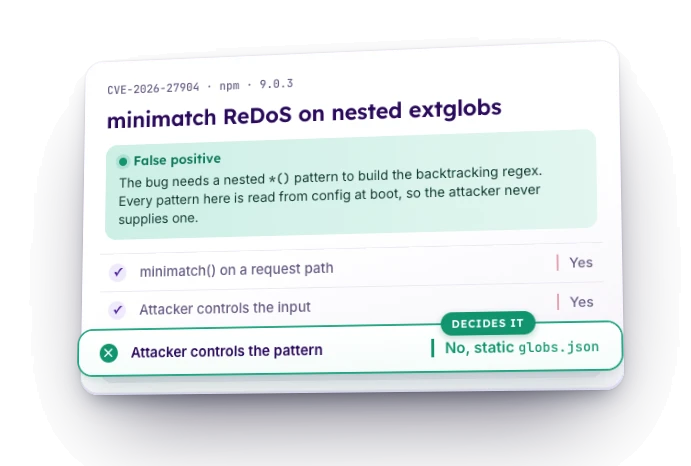
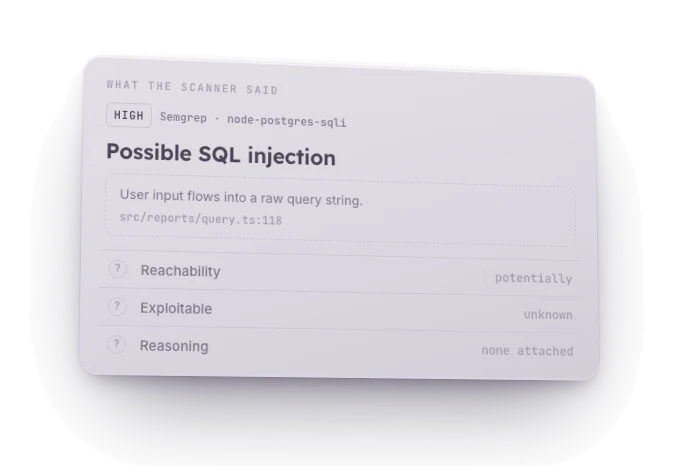
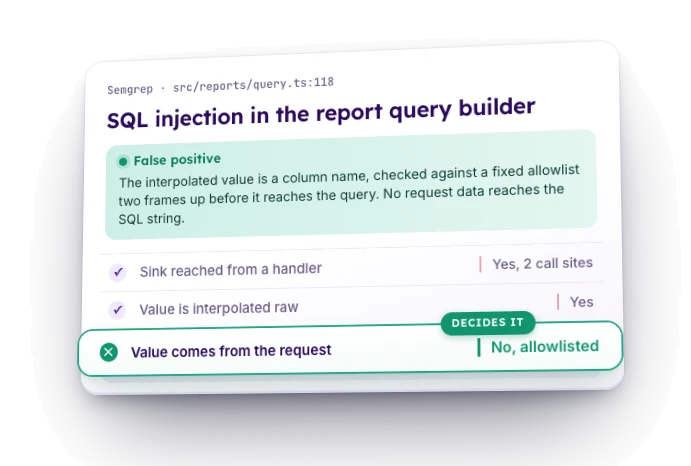
Severity is what you were told. Exploitability is what we prove.
One finding, seen two ways.
The short version
A finding arrives, gets investigated, and gets closed with the evidence attached to the ticket.

Every step at attacker speed
01
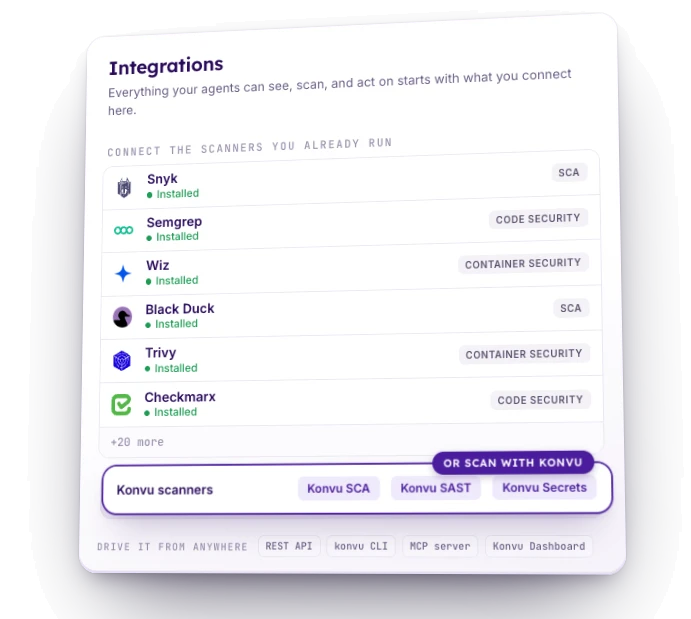
Connect
Keep the scanners you already run. Konvu reads their findings.
02
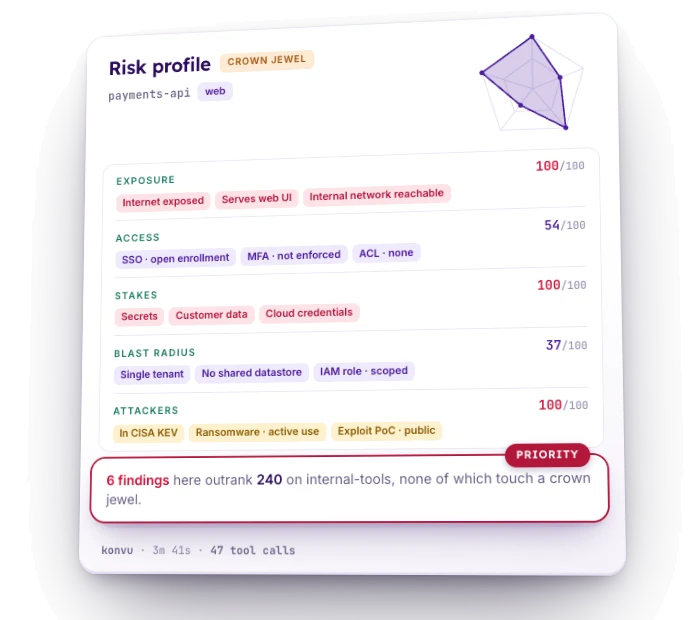
Enrich
What each service exposes and what it handles, joined to our vulnerability database, where the conditions that make each CVE exploitable are written down.
03
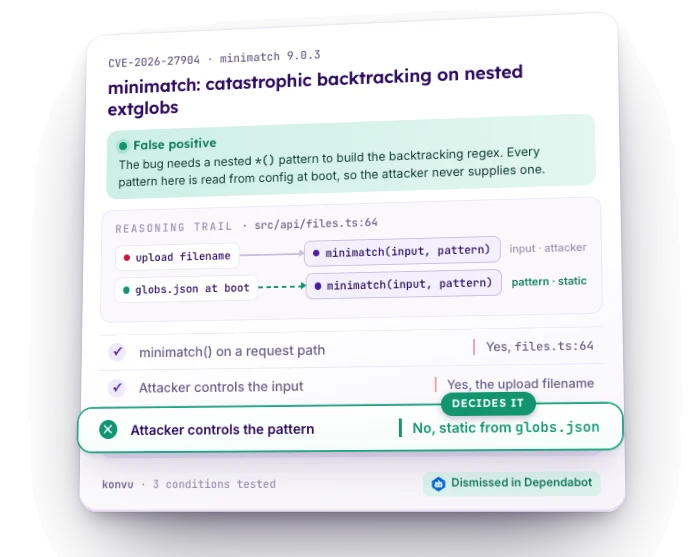
Prove
The verdict, with the reasoning trail and the code that decided it. One finding proved exploitable, one proved not, because a verdict only counts if it can come back either way.
04
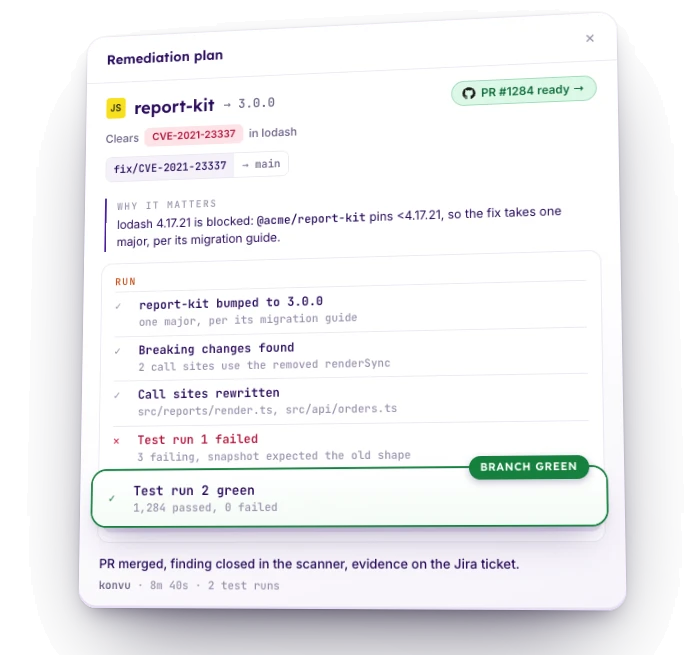
Fix
Breaking changes found, call sites rewritten, tests re-run until the branch is green. False positives are dismissed straight back in the scanner that raised them.
05
Prevent
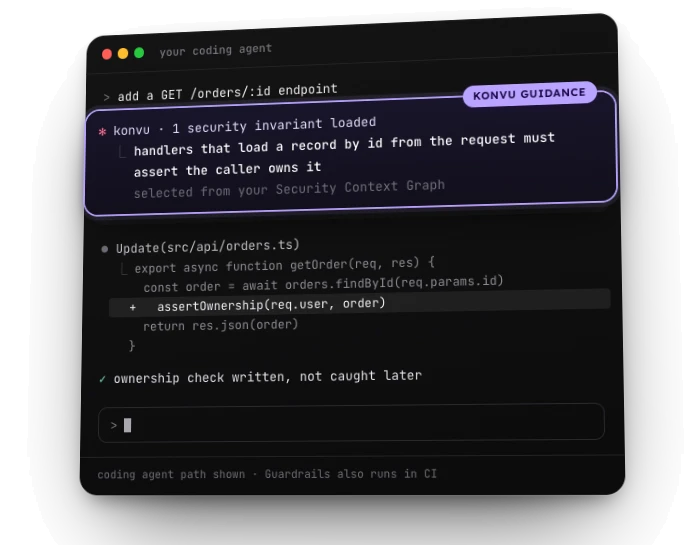
Tenant boundaries and approval flows can break without a dangerous call for a scanner to flag. Konvu checks relevant changes against security invariants in coding agents or CI.
Where a frontier model stops
We build on frontier models and they keep getting better. Four things they still won't do for you.
01
The question is narrower than the model
Is this vulnerability exploitable in this environment? Answering that needs almost none of a frontier model’s breadth. Narrow and deep beats wide and brilliant.
02
The conditions were never written down
Which function has to be called, with what input, under which configuration, in what deployment. For most vulnerabilities nobody ever recorded it, so no model learned it. We maintain a vulnerability database enriched with exploitability conditions, built one vulnerability at a time.
03
Models declare victory too early
A model that says “not exploitable” after an incomplete investigation produces a false negative that looks exactly like a clean verdict. Nobody pushes back, because nobody knows there was more to check. So the supervision lives in the system: bounded tasks, and verdicts that carry their evidence.
04
Graded on exploits, not on approval
Preference training rewards answers people rate highly. An exploitability verdict is right or wrong whether or not anyone liked reading it. We grade against ground truth our own security engineers labelled.
Proof from real deployments
All three companies are anonymised at their request. The numbers are not. Each one ran Konvu against a live backlog its own team had already been working by hand, so the comparison is against trained security engineers rather than against nothing.
Global Fortune 500
96% of findings assessed as false positives, each with written reasoning.
Several of the exploitable findings were low and medium severity. The 7.0 rule would never have opened those tickets.
Read the case study →Fintech SaaS
Developers stopped dreading the alert queue.
Exploitability context on every finding, and 3x faster remediation on the ones that mattered.
Read the case study →Fortune 500 retail
SCA triage queue cut by 93% in weeks.
The evidence trail on each decision made it safe to automate dismissals across an 80k-employee estate.
Read the case study →“Engineers love the evidence. They see that, and it ends many conversations.”
“There is one week a year when we don’t have pressure. That’s Christmas week. For fifty-one weeks a year, we’re dealing with high CVEs.”

Recognition
"The platform delivers two key outcomes: vulnerability prioritization and remediation, and is well positioned to solve both effectively."
James Berthoty, Founder at Latio
Read the full report →Fits the stack you already have
Konvu Agents write verdicts back into your scanners, open PRs in GitHub, and ping your Slack. Drive the whole thing from the REST API, the konvu CLI, or an MCP server your own agents call. No new dashboard. No rip-and-replace.










You decide what leaves your environment
Two deployment models. Konvu Cloud, or our Kubernetes controller running inside your own cluster, where Konvu never has access to your code.
Cloud or self-hosted
Run on Konvu Cloud, or deploy our Kubernetes controller in your own cluster. In self-hosted, Konvu never has access to your code.
Fits your toolchain
Plugs into Snyk, Wiz, Semgrep, and 20+ others you already run. Need one we don't have yet? We'll build it.
SOC 2 Type II
Independently audited and certified for security, availability, and confidentiality controls.
Configurable policies
Adapt to any workflow and regulatory environment. Define custom rules and enforce them automatically.
Privacy by design
Code is never stored by Konvu or model providers. Never used for training. Privacy guaranteed.
Expert-led support
From onboarding to deployment at scale, our team works alongside yours to ensure long-term success.
Latest from our blog
View all articles
How to Scale Vulnerability Triage Without Breaking Audit Requirements
Vulnerability volumes exceed human triage capacity, but auditors demand every finding accounted for. Evidence-based triage bridges the gap between scale and compliance.
Read
Why Static Code Reachability Is Not Enough: From "Reachable" to Truly Exploitable
Reachability vs exploitability: why a reachable function is not an exploitable one, and how exploitability analysis cuts false positives. Four real CVEs.
Read
The Future of Vulnerability Management
For the past decade, security measured progress by vulnerability count. Detection wasn't progress, it was paralysis. Learn how agentic AI changes everything.
Read